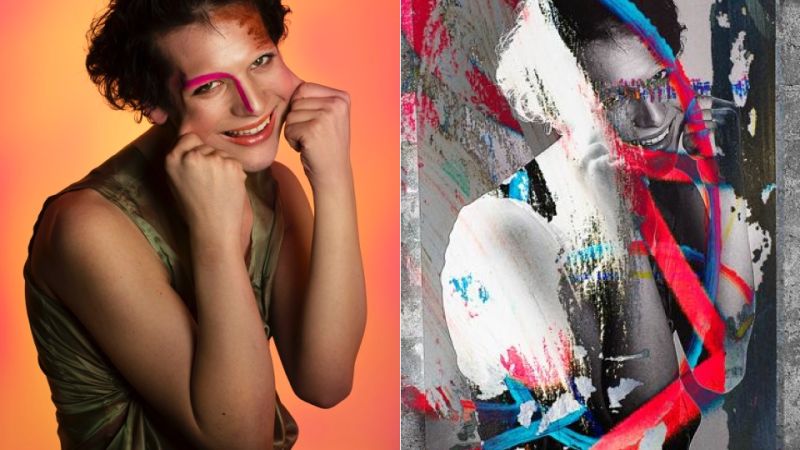
There are millions of paintings, photographs, comic designs, etc. that have been re-appropriated for millions of reasons. Appropriation of images is a common thing in art, because artists will learn by copying other art pieces, or by using similar styles in order to strengthen their skills. Many artists will also take famous paintings and re-appropriate them for commercial use, however for the example that will be explored that is not the case. In this case instead of looking at a famous painting that was appropriated, it is a photograph that has been altered and re-appropriated for other use, as well as the original photographer was never credited for creating the original piece. The left is the original (done by Arabelle Sicardi, and Tayler Smith), and the right is the re-appropriated version (done by Zak Arctander).
The denotations of this piece are that it’s a photo of a transgender actress and model, Hari Nef, (Hellyer, 2015) pulling her cheeks apart, as well as smiling. Hari Nef also appears to be wearing abstract high-fashion makeup. This photo, and photo series could have many meanings, an example is it could be a sort of emotional photo piece, as it might seem that Nef is pulling her own cheeks to make herself seem happier then she actually is. It could also just simply be a makeup appreciation series, showing different makeup styles and then explaining how they are done as Sicardi states “I’m gonna guide you through the portraits…and how to get the looks if you so desire,” in the introductory description (Sicardi, 2014). The photograph was actually done for New York’s American Two Shot(Cascone, 2015), in a 2014 exhibition called “Most Important Ugly.” It was a series originally done by Arabelle Sicardi and Tayler Smith (Julianne Escobedo Shepherd, 2015).Arabelle Sicardi came up with the idea to create these pieces because originally she created a questionnaire for Sephora called “Therapy Sessions” and after seeing the success of it she decided to expand the idea for an art show, so people part of the LGBTQ+ community or those considered “outcasts” were able to tell their stories. Each person that was photographed goes through an interview and is asked many questions about identity, shame, anxiety, and their history with makeup. The photos are of several people like Hari Nef telling their stories, in a biography at the bottom of each image (Sicardi, 2014).The photo series was only shown at an art show in New York, so the photos cannot be seen in person anymore, however they can be found online on the autostraddle.com website where Sicardi and Smith originally published them. Sicardi and Smith wanted to create this series to bring more awareness in society of different characters and people in the world who have suffered, survived, and dealt with many problems that not all average human beings could understand. They wanted to open the minds of their audience and many others with this show.
A year after the photo series had been created in 2014, a recent Yale graduate of 2015, Zak Arctander, took one of the photographs and altered the image for his own use, as can be seen above. He took the photo of Hari Nef, and used it as an art piece displayed at the Danzinger Gallery in “Lovely Dark: Yale MFA Photo 2015” and also “Regen Projects” later that same summer (Cascone, 2015).Arctander took the photo and converted it to black and white. He also partially obscured the portrait with graffiti and made it a 60 x 36 inch vinyl print (Casone, 2015). He renamed the piece from simply being called the name of the model “Hari Nef” to “Cheeks.” (Hellyer, 2015). By the name,Artander is most likely referring to the way Hari Nef is holding her cheeks, and pulling them apart,however, if there were a deeper meaning, it is still to this day unknown. After Zak Arctander’s gallery piece “Cheeks” was seen it was published in the next issue of the New Yorker under the panel “Freedom of Young Photographers” and credited towards him and not the two original women (Sicardi and Smith, 2015).It was an article to show how photography was expanding and growing into multiple new forms and ideas. The writer took many other Yale Graduate art pieces and used them as examples to show how creative photography is getting in his article as well (Als, 2015). The two original artists stated that Arctander’s work was lazy, bad, and “replicates the very ideology that the original photo pushed against.” (Sicardi, Smith, 2015) They attempted to reach out to Arctander to find an explanation behind what he had done, however after having his work slandered by these two artists, it can be understood as to why he didn’t reply. (Shepherd, 2015). Arctander was never sued or prosecuted for theft or plagiarism, because James Danziger (the proprietor) stated that because of the way Arctander changed the piece it is counted as “legitimate appropriation and transformative use.”(Cascone, 2015).
The two photographs both have different meanings. Although the real meaning to the second image is unknown, it can be understood that it does not have the same meaning as the original and took on its own meaning once it was made. However, it could be interpreted as they are both pieces that are trying to open people’s mind to new ways of thinking just in different things i.e. the original is opening people’s mind about different people in the world, the re-appropriated piece opening people’s minds about new ways of photography. The two pieces, once analysed, don’t look too similar, although once they are put side by side it becomes clear that they were once one in the same. The similarities that seem to be more represented in these two pieces, seem to be Hari Nef’s facial features which are still visible in both, the rest of Hari Nef’s body can also be seen but because a lot of it is covered by graffiti or in black and white, the face seems to stand out more.The original photo by Sicardi and Smith was more created for the sake of telling people’s stories so the image is relatively simple, however Arctander’s version of the piece is a lot more experimental in the sense that he uses different elements in the piece and not just taking the photo for what it is. He added randomly placed colourful graffiti into it, and by making it black and white made the graffiti stand out and be more eye-catching.
The two pieces were made several years ago however this seem to be very important and still speak to the artistic and societal struggles of modern society. The original still is relevant to this day because there are still many people in the world who would shame people like Hari Nef, and there are many artists like Sicardi and Smith who have not been credited for work they have done.
Word Count (without bibliography): 1,171
References:
Als, H. (2015) ‘The Freedom of Young Photographers.’ In: The New Yorker {online} At: https://www.newyorker.com/culture/photo-booth/the-freedom-of-young-photographers (Accessed on: 9/10/19)
Cascone, S. (2015) ‘Imitating Richard Prince, Yale Graduate Zak Arctander Appropriates Feminist Photography’ In: News Artnet {online} At:https://news.artnet.com/market/zak-arctander-appropriates-photo-311464 (Accessed on: 23/10/19)
Julianne Escobedo Shepherd (2015) Did a Yale MFA Jack Two Feminists’ Work & End Up in The New Yorker? {online blog} In: Jezebel At: https://jezebel.com/did-a-yale-mfa-jack-two-feminists-work-end-up-in-the-1712328434 (Accessed on: 4/10/19)
Arabelle Sicardi with Tayler Smith (2015) Here’s What Happens When Some Yale Bro Steals Your Art {online blog} In: The Muse Jezebel At: https://themuse.jezebel.com/heres-what-happens-when-some-yale-bro-steals-your-art-1713684895 (Accessed on: 4/10/19)
Sicardi, A. (2014) ‘Most Important Ugly: I Believe Makeup is Magic’ In: Autostraddle {online magazine} At: https://www.autostraddle.com/most-important-ugly-mars-and-melissa-and-the-baby-beginnings-242322/ (Accessed on: 9/10/19)
Hellyer, I. (2015) ‘queer artist’s photography appropriated by Yale graduate’ In: I-D Vice {online magazine} At: https://i-d.vice.com/en_uk/article/j5mamb/queer-artists-photography-appropriated-by-yale-graduate (Accessed on: 23/10/19)
List of Illustrations:
Figure 1. Sicardi, A, Smith, T(2014) Hari Nef {Photograph} At: https://jezebel.com/did-a-yale-mfa-jack-two-feminists-work-end-up-in-the-1712328434 (Accessed on: 4/10/19)
Figure 2. Arctander, Zak (2015) Cheeks {Digital editing on Photograph} At: https://jezebel.com/did-a-yale-mfa-jack-two-feminists-work-end-up-in-the-1712328434 (Accessed on: 4/10/19)
 OCA Art Blog