‘Craft’ has many meanings but, increasingly, it’s used in a positive sense to refer to quality, skill, refinement, and authenticity in making.
“To a designer, ‘craft’ is about the workmanship of risk and-most recently- the slow design movement” (Frayling, 2011, p.11)
The revival of the interest in craft process coincides with recent moves towards ‘Slow Design’ which has evolved from the Slow Movement and the Slow Food movement.
All focus on promoting wellbeing for individuals, the environment and society, and promoting development towards sustainability. Slow Design, however refers to the approach of the designer and their intentions, rather than the designs themselves.
Floor Nijdeken’s Crossover Collective not only provides a platform for Slow Design sonf immersion in a traditional craft, but also allows for collaboration.
Jeffree Star Cosmetics is an online makeup brand, that is only sold in physical stores of Ulta, Morphe, Marionnaud, and a few others. His products are meant to be like eco-friendly, and cruelty-free. He has products which are also vegan, paraben free, and gluten free.
Jeffree Stars products are all cruelty-free which means they are not tested on animals indicating that “makeup is for humans, and not animals.”
On his makeup website, he also states on a F.A.Q. “Are you products cruelty-free?” Yes, our whole line is cruelty-free! Makeup is for humans, not animals. We have also researched our manufacturers and know 100% they don’t affiliate or get ingredients from places that are not cruelty-free! https://jeffreestarcosmetics.com/pages/faq
The last sentence is very important because it ensure his clients that the products aren’t tested on animals and also there aren’t any animals-based ingredients in the makeup products i.e. to make eyeshadows red, many brands typically use Carmine which is crushed up red pigment from cochineal insects. This makes his products also vegan.
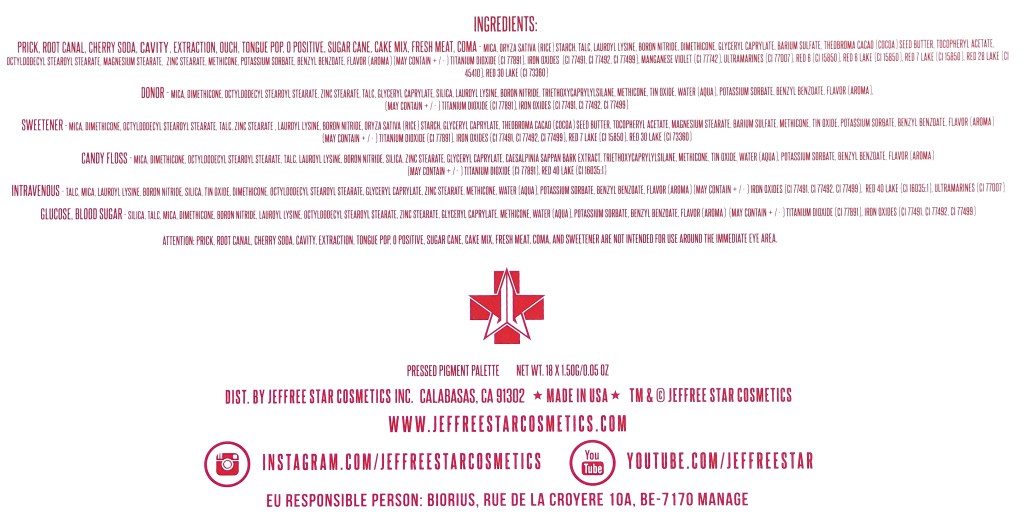
The back of every single of Jeffree Star’s palettes all have a list of all the ingredients used, and any disclaimers necessary. This palette is vegan which means all the red colours have no carmine dye in them Jeffree Star used other dyes that are vegan, the only difference they make is sometimes the colours stay a small amount, however it is not dangerous!
Tracking and tracing origins and processes has become an increasingly important part of the production of any product, including textiles. Even though many companies claim to have ‘great transparency’ they only really tell you where the product was made, but never mention where the materials were form or components are sourced, or production process of employee treatment.
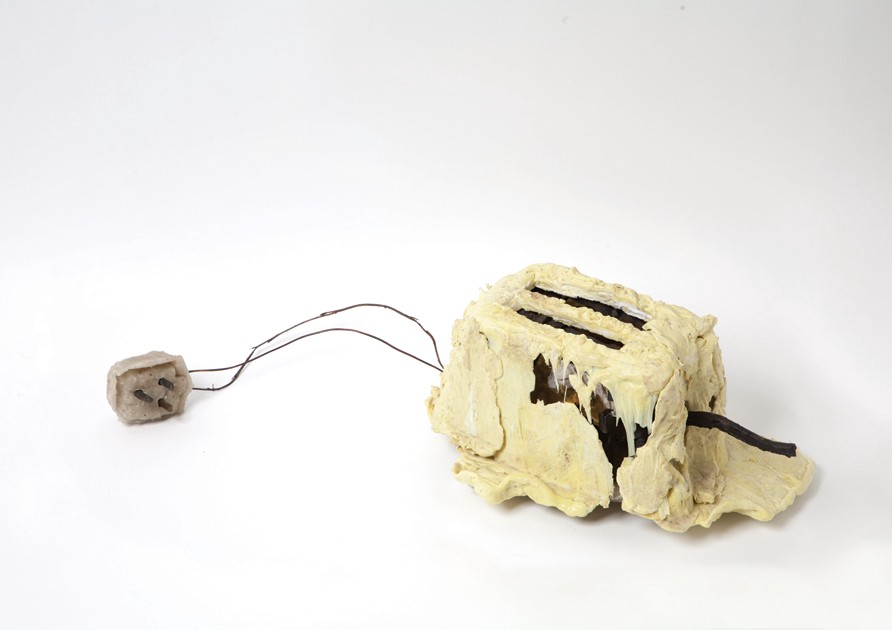
Thomas Thwaites is a British designer and writer who sought out to build a toaster that only costed £3.99. He did this in order to analyse the complexities of manufacturing, he questioned the sourcing and creation of an object that we are everyday consumers take for granted.
In order for him to make this toaster he mined his own metals, created his own plastic, and demonstrated how amazing the making of a simple toaster is.
A company that has developed a set of “practice-based sustainable design strategies that assist designers in creating textiles that have a reduced impact on the environment” http://www.tedresearch.net
TED’s TEN (ten criteria points for designers and makers to follow):
Design to Minimise Waste
Design for Recyling/Upcycling
Design to Reduce Chemical Impacts
Design to Reduced Energy and Water Use
Design that Explores Clean/Better Technologies
Design that Looks at Models from Nature and History
Design for Ethical Production
Design to Replace the Need to Consume
Design to Dematerialise and Develop Systems and Services
Design Activism
Many textile manufacturers and users also look for ways to lessen the environmental impact of their production and shine less negative light on the industry. Most significant environmental problems arising from textile production are the use of dyestuffs to add colour and the necessity for water in textile production.
A Swedish company “WeAre SpinDye” has tried to take a stand and come up with a way of dyeing fabric whilst making less of a negative impact on the environment. The way they do it is that the fibre is already dyed during the spinning process, which allows the dyeing of yarns or fabrics to become obsolete, saving resources and costs.
Adidas and H&M are investing in technology to use less water and therefore reducing the pollutants released.
The processing and making of textiles in one of the most polluting industries in the world!
Sustainability is difficult to simply define. We need to consider three aspects:
Economy
Society
Environment
Sustainability is when something has been made using earths natural resources that can be regrown and is essentially never ending. i.e. sustainable forms of energy: solar power, wind power, hydropower, thermal energy etc.
Defining Sustainability: The ability to be maintained at a certain rate or level.”the sustainability of economic growth.” Avoidance of the depletion of natural resources in order to maintain an ecological balance. https://www.lexico.com/en/definition/sustainability
In what contexts is sustainability an issue:
Energy: There are both sustainable and non-sustainable sources of energy and our society for the most part uses non-sustainable sources of energy i.e. fossil fuels. that severely damage the environment.
Methods of construction/building: buildings consume 20 – 50% of the physical resources, according to their environment. Buildings are also a direct cause of pollution because of the emissions produced in them or their impact on the ground. To better this problem architects need to try and use more durable, reusable, and recyclable materials. https://www.activesustainability.com/construction-and-urban-development/sustainable-building-materials/
Methods of transportations: There are many methods of transportation that are not sustainable, and their sources of fuel are all man-made sources that’ll eventually runout, which is why now slowly people are creating electrical cars, or solar powered vehicles which are more sustainable and create less pollution.
Packing Materials: There are many materials use in everyones daily life that are large contributors to the pollution in the environment and effect nature, however the products are most of the time more economically sustainable so they are used i.e. plastic bags, plastic can holders (anything plastic), cans, bottle caps, etc. These are all examples of non-sustainable materials that damage the environment on a daily basis.
How do you think sustainability might be addressed in relation to the production and consumption of textiles and other manufactured products?
There are many small retail companies, that aren’t very big or well-known which create many eco-friendly and sustainable pieces.
thredUP is a company that is eco-friendly is known for upcycling all their products. Upcycling: the process of transforming by-products, waste materials, useless, or unwanted products into new materials or products of better quality and environmental value.
Reformation is another company which, uses sustainable products, pay living wages, has a plus size line, and purchases carbon offsets AKA funding for projects that help reduce greenhouse gases, companies do this to help reduce their carbon footprint etc.
Agricultural farmers and textile farmers typically use the crop-rotation agricultural method which is the most sustainable form of agriculture.
Crop rotation is the practice of planting different crops in the same area at different times of the year or in different years. This method reduces pesticide and herbicide use, as well as fertilizer use, and there for wears down the crop fields slower.
Climatex is a company which pays attention to recycling, environment, health and energy in the design of its products. They have come up with a new innovative form of industry that creates sustainable and 100% recyclable textiles, their upholstery fabrics are return to the production cycle, consumption, and renewal after their useful life.
Example of Recyclable Fabrics (look just like any of fabric)
Aircrafts are a huge cause of CO2 emissions ever year, the United States contributed 23.5% (202.5 million tons) of global CO2 total emission of 2017. The heavier or bigger the aircraft the more CO2 emissions. Lantal (a textiles for transportation company), developed a new type of aircraft carpet that is significantly lighter than conventional aircraft carpets. Depending on the aircraft type and route profile, airlines can use this type of carpet to reduce their CO2 emissions per aircraft per year by around ten tons alone!
Textiles play a range of roles in all of our lives and therefore come in many forms. Traditionally, the textile discipline has been split into distinct areas of constructed and printed textiles, although these categories include many means of making.
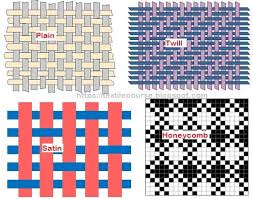
Constructed textiles can be made through knitting (by machine or hand),through weaving or through other processes where fibres or chemicals are united, extruded or bonded to create a pliable material. Knitting and weaving is still the most efficient and successful means of creating sufficient quantities of textiles for our needs, but modern technology (3D printing) has also meet our personal demands more.
Printing textiles and employing other embellishment and textiles finishing techniques, i.e. embroidery, laminating, or coating allows us to apply further aesthetic qualities onto the surface of a textile or to alter the qualities a constructed textile possesses.
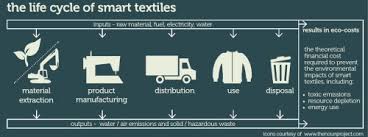
Material life cycle: The concept of material life cycle has become extremely relevant in. a world thats increasingly ware of wastefulness, longevity and our individual consumption of products. Creating textiles or any product forces the designer, manufacturer, and maker to consider what the consequences of that product will ultimately be.
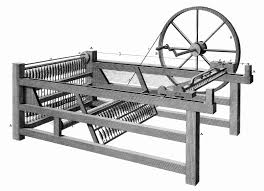
The Spinning Jenny was a machine invented in the early Industrial Revolution that was one of the key developments in industrialization. It is a multi-spindle spinning frame invented by James Hargreaves in 1764. https://en.wikipedia.org/wiki/Spinning_jenny
The term ‘textiles’ is increasingly shifting from traditional notions of constructed and printed/surface embellished textiles towards textiles as materials used in a wide range of contexts.
The life cycle of textiles and materials: Textiles as physical made materials and explores the journey they follow from cradle to grave or, as sustainability demands, from cradle to cradle.
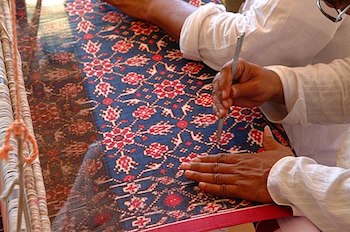
The revival of craft and the hand-made: The process making the time involved and the craftsmanship applies. Society re-evaluating the play-off between mass-produced and craft-produced objects.
Clouds and pillars: Textiles within the context of defined spaces, as temporary or permanent installations, structures or environments. Textiles can play an important role in transformation, defining, or forming the environment.
Enveloping the body: Looking at textiles on a personal scale and considers the innate characteristics of textiles in relation to the body and as clothing. The application of textiles thyoughboth their distinguishable qualities and the creative room for experimentation in their design and creation.
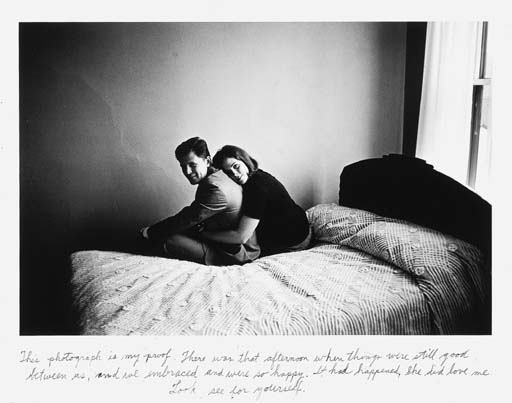
Fig.1. This photographs is my proof. There was that afternoon, when things were still good between us, and she embraced me, and we were so happy. It did happen, she did love me. Look see for yourself!’ (1967)
Fig.2. Dr.Heisenberg’s Mirror of Uncertainty (1998)
What is it about Duane Michals’ photography that makes it so irresistibly insightful, and why does he chose to portray his work in this way? Duane Michals’ photography immediately stood out because of the way it’s done, and the uniqueness of his style. Michals is an American photographer who creates photo-sequences often to exhibit emotion. His pieces combine photographs with handwritten texts which expand on the meaning of the piece. It is a very absurd way to do photography, as art is always seen as it’s meant to speak for itself and not require explanation or description, however Michals throws that concept entirely out of the window with his work. He plays with the concept of photography, by the way he combines his photos with large amounts of texts, and even creates small stories with some of his pieces. It is a form of photography that can evoke the audience to ask different types of questions they wouldn’t have even come across if the text or image wasn’t present.
Michals’ photography is very specific, yet each image is completely different to each other, and all seem to tell a story. Although the concept of photography is to have one dominant photo telling the whole story, Michals prefers to have multiple photo sequences, or even small handwritten sentences/poems at the bottom of his photos, by doing this he has blurred the lines between photography, and other disciplines (FundaciónMapFre, 2017). He’s always considered himself a bit of a storyteller in that sense (DC Moore Gallery, 2014-2015). The majority of Michals’ images are taken in black and white, and aren’t done on big oversized canvases. They are usually made on standard 8×10 inch. (20×25 cm) canvases, however his images still radiate substance and energy, even without the big splash-of-colour pieces (Vargo, 2014) . The amount of text varies from piece to piece, however most of them have a small description or commentary, enriching the image and giving though-provoking ideas for the viewer to dwell on. His images are fairly simple, however once you add the text they truly come to life, and with the little bit of information given, he opens up the viewers mind to a multitude of perspectives. His philosophy is “My pictures are more about questions, not answers,” (Strecker, s.d.) which rains truth when looking at both Fig.1. and 2 because of the way it creates so many unknown possible outcomes for his audience to imagine in their minds. Duane Michals gives the audience a chance to see his photography, understand what he was photographing, and come up with their own interpretation, as well as question what his interpretation was.
Duane Michals’ photos explore all types of themes and subjects; sex, death, dreams and memory, youth and age, and even subjects of celebrities, and religion (Vargo, 2014)). These are all themes that can either be perceived as quite unusual or very understandable. He states that “photographs should be provocative and not tell you what you already know,”(Strecker, s.d.) which is why he likes to add text to his photos or create photo sequences to try and get the viewer’s mind to work and construct a story of what the photo represents; a concept brought up by David Seidner in an interview with Duane Michals (Seidner, Michals, 1987). In Fig.1. he is seemingly trying to convey an emotional message, and could also have his own personal emotional attachment to the image. The message is written in first person, and is a sad reflective image on a past relationship, it is also handwritten, and the writing is even crooked to make it seem more realistic. His photos can also have text that is scratched out, or uneven, or with hard to read handwriting to make it seem more personal. There could be many meanings behind Fig.2. “Dr.Heisenberg’s Mirror of Uncertainty,” it could be seen as a piece to represent uncertainty and insecurity that has been build into women’s society for decades. However, the photo-sequence was actually made for French Vogue in 1998, as a quantum physics photo-sequence to represent Dr.Heinsenberg’s Uncertainty Principle, it is very interesting how the photo story can speak at so many different levels. (Andreasson, 2015).
Michals’ pieces require both the photograph and image to truly create its uniqueness. If you look at Fig.1. the photo alone is quite simple and not too interesting, but once it’s paired with the text it creates a powerful completed piece. The image is perfectly captured and could create so many questions, as to why it was taken, and if it was staged or naturally taken, however it is a fairly simple image. The text is an emotional piece of writing that could either have been written before the image was taken or after it was taken, which is what adds such intrigue to it. The text gives the audience a chance to view the piece the way that the photographer meant for people to see it, and also gives them a chance to relate to the piece as most people have had at least one heartbreak in their lifetime and could easily understand the situation the man in the image is going through. In Fig.2. the images without the context or text, although very different from other photos, it still would just seem like a model having fun with a funny mirror found in a random second-hand store in Bath (Andreasson, 2015). In cases where he doesn’t use text, e.g. his photo-sequences, the images on their own often don’t mean a lot, but once put together they can reveal a brilliant story. Once you combine both the image and text you create something truly interesting and different that not many photographers could do. Michals’ way of photography makes it necessary to have both the photograph and text to create the right impact.
Duane Michals’ photography style, as previously stated, is unlike many other artists, which is what makes it so captivating. His art is made to create questions, and cause intrigue for the viewer. With the small bit of information Michals’ gives his audience in his photos the viewers are given the opportunity to draw to millions of different conclusions, and reconstruct dozens of different story, they would’ve never thought of if it wasn’t for the way he captures his art.
The first image is a close up image of the merging of several farmer fields, it is a fairly simple image that many viewers could simply ignore because there is nothing particularly interesting about the image. The second image is a landscape photo of a city, however what makes it interesting is the several layers in the image, you can see the roads, and cars, but can also see large skyscrapers, and small homes and houses, as well as the sky, that adds immense character to the piece.
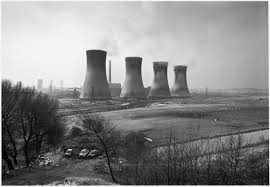
By being able to see the towers from a upper level you are able to see how grand the towers are, as well as the gravity of the air pollution. The fact that you can see a children’s football match gives an almost eerie, and scary feel, because you these small children who were just enjoying a football match in the sun are also being exposed to immense air pollution that could cause so many health problems. I believe this image is meant to be a subtle nudge to the negative effects of our decisions a as society, and how badly it effects the environment we live in.
Perspective is everything when it comes to photography, depending on where the photo is taken and from what angles, it can completely chance what the viewer would focus their attention towards.
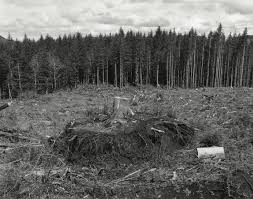
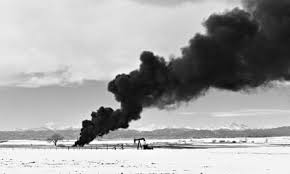
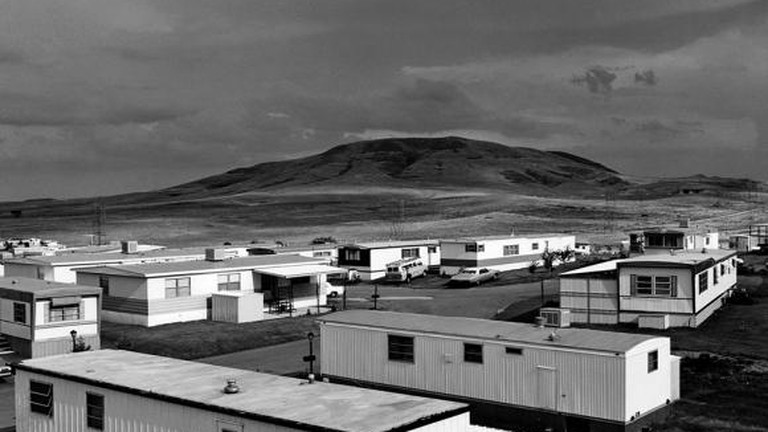
Robert Adams is one of the photographers who took part in New Topographics, and after it had finished he continued in producing pieces that were subtle, thought-provoking, and environmentally aware photographs.
He takes ‘breathtaking’ photos of man-altered environments as subtle nudges towards environmental issues. As seen bellow in fig.1.
He is able to see the beauty in all the ugliness, and shows how at times they could be one in the same. His black and white photos of Western America aren’t of the beautiful nature, they are of all the man-altered environment, and how much society effects the environment and has changed it for their own use.




 OCA Art Blog
